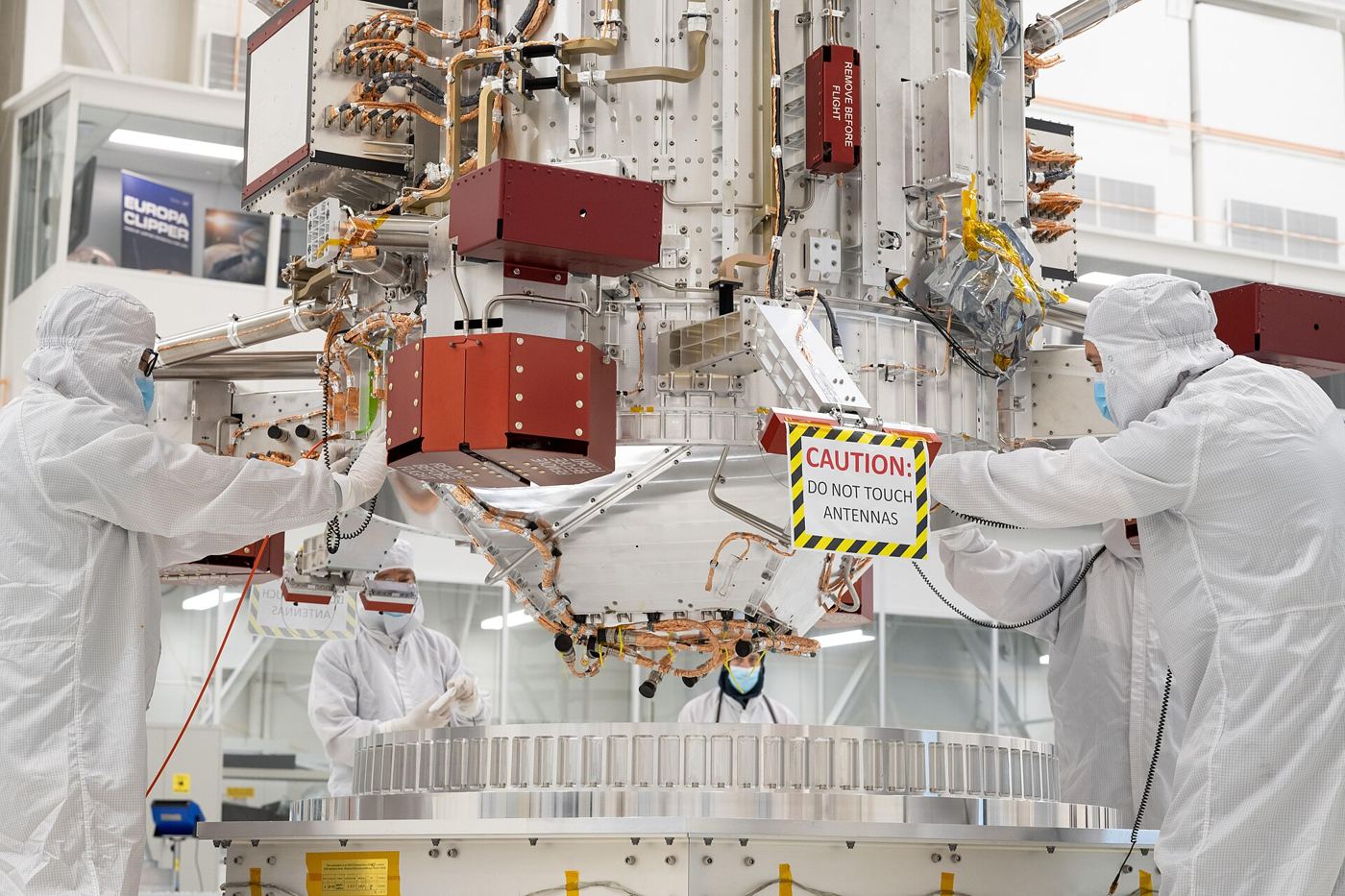
Jupiter’s moon Europa hides one of the most promising places in the Solar System to look for life, and a NASA spacecraft is now on its way there. Europa Clipper launched on 14 October 2024 aboard a SpaceX Falcon Heavy rocket from Kennedy Space Center in Florida, beginning a journey of about 3 billion kilometres that will end with arrival at Jupiter in April 2030. Beneath Europa’s cracked shell of ice lies a global salty ocean that scientists estimate holds about twice as much water as all of Earth’s oceans combined. The spacecraft, the largest NASA has ever built for a planetary mission, carries nine scientific instruments, including ice-penetrating radar, cameras and a magnetometer, and it will make 49 close flybys of Europa to study the ice and the ocean below.
What the Evidence Shows
Europa Clipper will not land and it cannot see through the ice directly, so its science is a detective job. The radar will probe the ice shell’s thickness, the magnetometer will measure how the ocean responds to Jupiter’s magnetic field, and spectrometers will sample the thin atmosphere for molecules vented from below. Together the measurements should reveal whether the ocean is habitable: whether it has liquid water, the chemical ingredients for life and an energy source. The spacecraft also carries a thermal imager to look for warm spots where ocean water may be welling up through cracks in the ice. The mission’s designers chose flybys rather than orbit because Jupiter’s intense radiation would destroy an orbiter quickly, so Clipper swings past Europa and retreats to safety between visits, gathering its evidence in brief, daring passes. Its findings will decide whether a future lander is worth the risk. Reporting and analysis from sources such as Nature track the same developments, and specialists following Europa Clipper mission to Europa say the direction is now consistent across independent lines of evidence.
The Wider Context
The wider context is a research landscape in which replication and open data now decide reputations. Findings connected to Europa Clipper mission to Europa are being checked by independent groups with shared datasets, and the teams involved publish their methods in full so rivals can test every step. That discipline is slower than a headline cycle, but it is why results in this area increasingly survive first contact with scrutiny.
What Happens Next
What happens next in the story of Europa Clipper mission to Europa will be decided by follow-up work already under way: larger samples, longer observation and instruments that have not yet come online. The researchers involved are unusually united on one point, that the current results justify the next investment of time and money. Readers will not have to wait long for the first tests of that claim. You can follow related developments in our coverage of science.
None of this will be settled by a single announcement, study or product launch. The pattern to watch is accumulation: independent confirmations, honest reporting of failures and steady improvement in the underlying numbers. Readers who follow those signals, rather than the loudest claim of the week, will understand this subject better than most of the commentary surrounding it suggests is possible.
