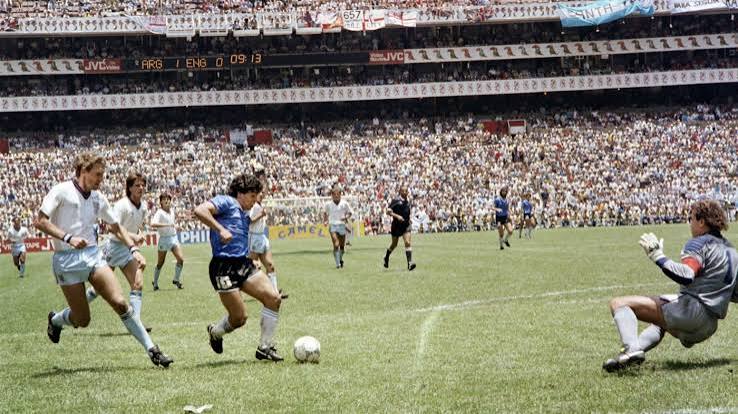
The 1986 World Cup quarter-final between Argentina and England is remembered for two Maradona goals that sit at opposite ends of the football spectrum: one illegal and cynical, one widely regarded as the greatest solo World Cup goal ever scored. Watching the full match, you see not isolated magic, but how Carlos Bilardo’s structure, England’s conservative plan, and the match tempo created the conditions for both moments to happen in the space of four minutes.
What the broader tactical context looked like before the goals
Before the 51st minute, the game is cagey rather than wild. Argentina play from a narrow base, with Maradona operating as the free “enganche” in what is essentially a 4-3-1-2, drifting laterally to find space between England’s midfield and back line. England, still influenced by the recent Falklands War context, approach the match conservatively, sitting deeper and using longer passes into relatively static forwards who receive limited support between the lines.
From a viewing perspective, the key early pattern is how often Maradona receives on the half-turn with at least one England midfielder trying to track him but never quite cutting off the lane. Each time Argentina break England’s first line, the ball tends to find Maradona’s feet in the right half-space, and the tempo spikes momentarily as he drives forward or slips runners in. That rhythm—slow circulation, then a sudden accelerant through one player—sets the tone for how shocking the two second-half goals will feel when they arrive.
The “Hand of God”: how an unremarkable move became a global flashpoint
The first goal begins with a relatively innocuous situation. Maradona darts through the inside-right channel and plays a one-two that leads to a contested ball in the box with goalkeeper Peter Shilton rushing out. The cross and defensive header loop awkwardly, creating a half-second where both players see an opportunity: for the keeper, to punch clear; for Maradona, to attack the same ball despite being shorter and coming from behind.
Live, the key viewing detail is how quickly Maradona commits to the challenge and how his body shape disguises the use of his left hand. He jumps with his arm angled upward, fist closed, and makes contact on the blind side of both Shilton and most of the officials, nudging the ball over the keeper and into the net. On grainy 1986 broadcasts, the deception is effective enough that many spectators only suspect rather than know; it is only in replays and stills that the offence becomes obvious. The incident teaches a wider lesson for live viewing: marginal, crowded-box actions are often decided by micro-movements you cannot fully verify in real time, which is why modern VAR exists for exactly these situations.
The “Goal of the Century”: structure, space, and timing
Just four minutes later, Maradona scores what FIFA voters later call the “Goal of the Century”: an 11-second dribble that begins in his own half and ends with the ball in England’s net after he beats five players and the goalkeeper. On a highlight reel, it looks purely individual. In the full match context, it emerges from both Argentina’s spacing and England’s stretched shape as they try to respond to the first goal.
Maradona receives the ball just inside his own half, near the right touchline, with Peter Reid and Peter Beardsley closing in. Argentina’s shape pulls England’s midfield line slightly left, leaving a central lane that Maradona can attack once he slips between those first two challenges. As he accelerates diagonally, England’s defenders backpedal but do not commit early, wary of a pass to a supporting runner. That hesitation gives him time to feint past Terry Butcher, glide around another defender, and finally round Shilton before finishing from a tightening angle.
How watching the full match, not just clips, changes your perception
If you only see the two goals, the match feels like a story of individual genius and controversy. When you watch the entire game, you see how often Maradona has already rehearsed elements of the second goal: receiving wide right, cutting inside on an angle, and using changes of pace to unbalance a block that is organised but not particularly dynamic. Those earlier, less decisive dribbles prepare both him and the viewer for what is coming, even if the final execution still feels impossible.
Viewing the full ninety also helps you understand England’s response. After going 2–0 down, they push higher and eventually score through Lineker, compressing the scoreline back to 2–1 and nearly equalising late on. That closing phase shows that the game is not purely one-way; instead, it becomes a complex contest in which one player has already delivered two actions that decide the tie before England’s structural adjustments start to pay off.
A side-by-side look at the two goals as live experiences
Because the match is often reduced to those two moments, it helps to compare them directly—not to revisit their morality, but to understand what you can learn from each as a live viewer. One is low xG but certain once scored; the other is a sequence of continuous decisions and micro-duels that constantly threaten to break down.
| Aspect | “Hand of God” first goal | “Goal of the Century” second goal |
| Starting situation | Broken ball in and around the box after a combination and deflection | Controlled reception near halfway on right flank with time to face forward |
| Key decision point | Maradona chooses to attack a 50–50 with Shilton using his hand, betting on deception and poor viewing angles | Maradona decides to carry rather than pass early, exploiting England’s loose spacing and slow engagement |
| Defensive context | Crowded area, many bodies, limited visibility for officials, keeper leaving his line aggressively | Backpedalling defenders, large central spaces, poor cover and support timing from midfield |
| Viewer perception live | Ambiguous; feels suspicious but hard to prove without replay, especially on 1986 broadcast quality | Visceral; each dribble touch raises tension because defenders have repeated chances to stop the run but cannot |
| Lesson for reading matches | Understand that tight, aerial box duels are often decided by tiny, hidden infringements that may escape real-time detection | Recognise when one player’s technical level and balance relative to the block turns half-spaces into continually exploitable corridors |
Seeing both in full context shows why the game holds such a unique place in football memory: it contains, in minutes, a compressed study of both the darker and the transcendent sides of individual impact within a structured match.
How ideas like xG and chance quality map onto Maradona’s goals
If you “translate” these moments into a modern statistical lens, the contrast becomes even clearer. The first goal, once you remove the handball, is essentially a low-probability aerial duel for a looping ball, with the keeper favourite to claim. The expected-goals value for such a chance would typically be modest; it only becomes 100% once the illegal contact directs the ball past Shilton.
The second goal starts from a situation that most models treat as very low xG—ball near halfway, multiple defenders in front, no numerical overload. What raises the real-world probability is Maradona’s repeated success in winning individual duels: each beaten man increases the threat level. From a live viewing standpoint, the key is noticing how he continually shifts the ball onto his left foot while maintaining forward momentum; every successful touch forces England’s defensive line into worse positions, effectively upgrading the chance with each step before the final finish from inside the box.
Mechanism: why some actions “break” our intuition about odds
These two goals demonstrate why raw xG can never fully capture how it feels to watch certain actions unfold. In the first case, your intuition lags because you do not immediately see the illegal contact; in the second, the long-distance origin intuitively feels unlikely, yet the dribble’s successive wins over defenders gradually move the chance into “must-score” territory before the shot.
For viewers, the mechanism to watch is the chain of micro-events rather than the starting position. A sequence that begins low in probability can become extremely dangerous if one player repeatedly makes high-level decisions and technical actions without interruption. Conversely, a sequence that starts from a seemingly promising box position can be less dangerous than it appears if the shooter’s balance, angle, or pressure is poor, or if the goal is assisted by an unseen infringement.
What you can watch for in similar matches today
Matches rarely feature moments as iconic as these, but the underlying patterns recur. Whenever a side has a dominant ball-carrier with the license to roam—whether that is a modern number ten or a wide forward coming inside—you can watch for their “rehearsal” dribbles early in the match, noting which channels they target and which defenders struggle with their balance and change of direction.
At the same time, in crowded-box situations, it is useful to practice separating what you know from what you infer. If you do not see clear contact, holding the possibility of a hidden push, pull, or handball in mind can keep your analysis grounded, especially before multiple angles appear on replay. That habit helps you stay calm when watching high-stakes games where single incidents—penalties, disallowed goals, mysterious ricochets—seem to swing entire narratives in seconds.
Summary
Argentina vs England in 1986 endures because it condenses ดูบอลสด changy extremes into a single quarter-final: an illegal, opportunistic goal that exploited the limits of human perception and an all-time solo run that maximised one player’s technical and physical gifts within a structured plan. When you watch the full match with attention to Maradona’s positioning, England’s conservative setup, and the chain of decisions leading into both goals, you turn a famous highlight reel into a lesson on how individual brilliance and tactical context interact—insight you can carry into how you read decisive moments in today’s biggest games.
